Does my voice get recorded or uploaded?
No. PowerCue uses Apple's on-device speech recognition to track your place in the script. The audio is analyzed live on your Mac and discarded; nothing is recorded, stored, or sent anywhere. The only network calls the app makes are license activation and the update check.
The permission dialog says speech data "will be sent to Apple". Is that true?
No, not for PowerCue. On macOS 26 and later you will not see that dialog at all: PowerCue uses Apple's newer on-device engine, which needs only the microphone permission. On macOS 14 and 15 the dialog appears, and that sentence is Apple's standard notice, shown to every app that asks for Speech Recognition whether or not it uses the online engine. PowerCue requests Apple's on-device engine only (it refuses to run any other way), so audio and recognized text never leave your Mac. You can confirm it yourself: unplug the network and Follow keeps working.
How does voice following actually work?
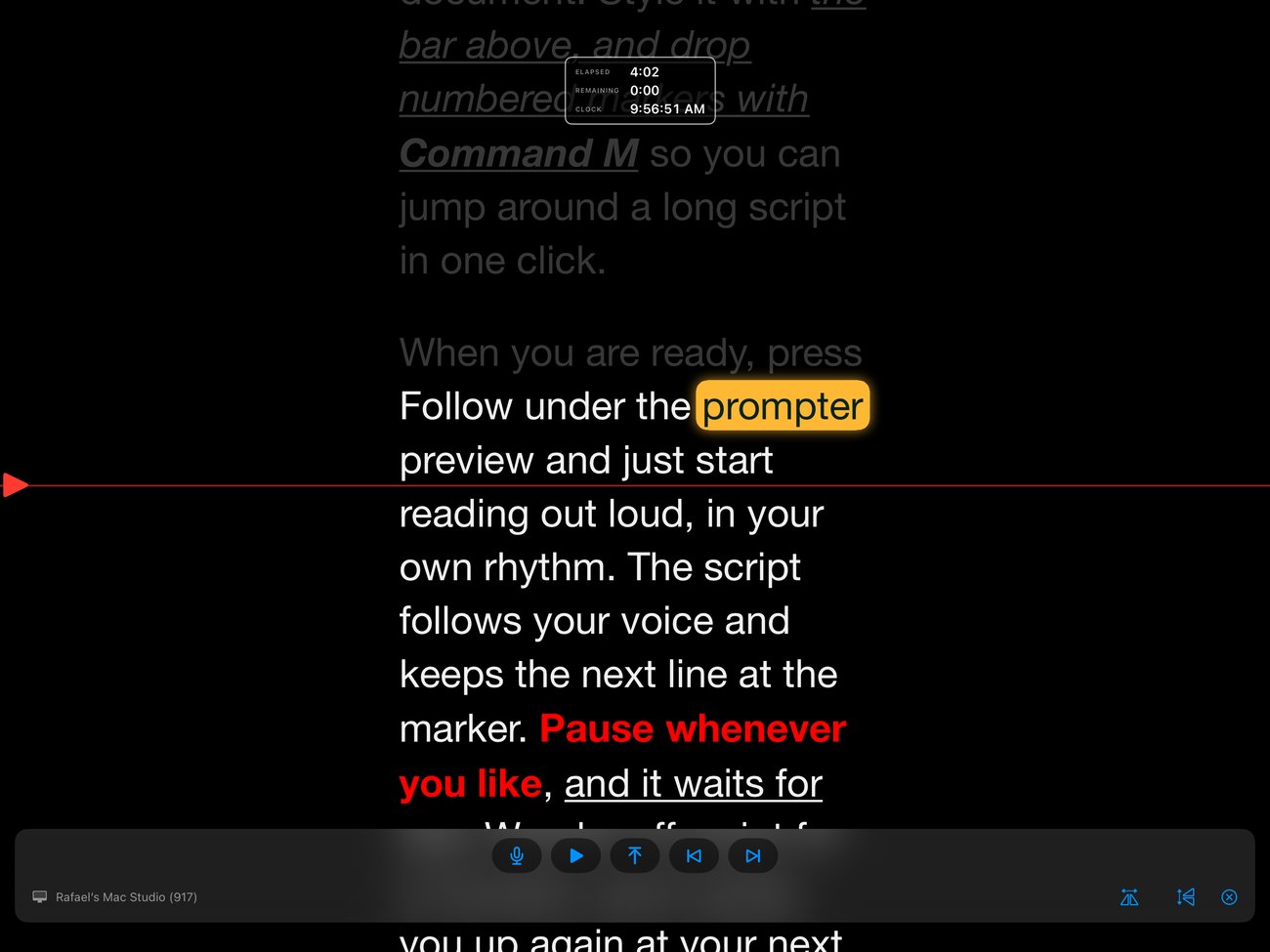
Press Follow and PowerCue listens through the microphone you picked, matches what you say against the script word by word, and scrolls so the line you are speaking sits at your marker. Pause and it waits. Ad-lib and the script holds still, then re-anchors when you come back to your lines. Stumble and restart a line, and it jumps back to it. Edit the script mid-session and it re-syncs to your place.
What if I do not want it listening at all?
Use Play mode: a classic timed scroll, paced either by a seconds-per-line speed slider or by a total run time you set (the script then finishes exactly on time). The karaoke highlight still tracks the pace marker, and the spacebar starts and stops either mode.
Does it work with beam-splitter teleprompter hardware?
Yes. Detach the prompter window, drag it to the display feeding your glass, and flip it horizontally, vertically or both. The whole window flips, controls included, and the editor keeps a normal unflipped preview that stays perfectly in sync.
Can I use a second monitor, an iPad, or my iPhone?
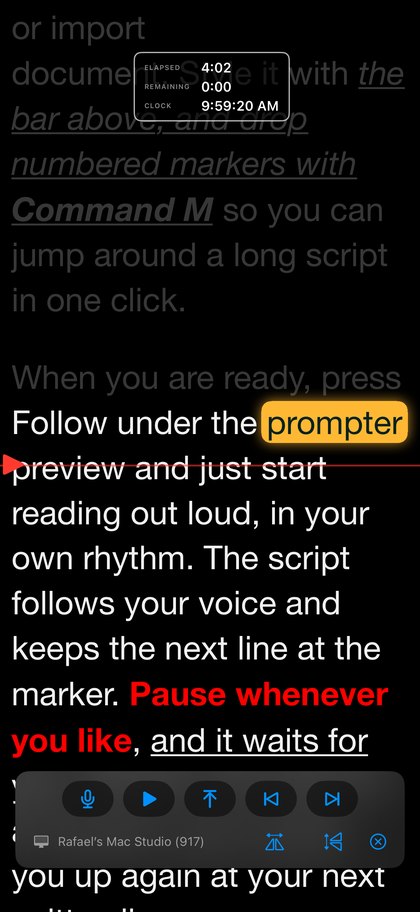
The prompter is a normal Mac window: put it fullscreen on any connected display, a second monitor, a projector, or an iPad via Sidecar. For a wireless screen, install the free PowerCue Companion on an iPhone or iPad on the same Wi-Fi: it finds your Mac, mirrors the prompter in lock-step, and can even act as the microphone. The edit window keeps a live preview, and scrolling any surface moves them all.
Is the Companion app available in my country?
Everywhere except the European Union for now. The Companion app is waiting on approval for the EU App Store storefronts, so it cannot yet be downloaded in: Austria, Belgium, Bulgaria, Croatia, Cyprus, Czechia, Denmark, Estonia, Finland, France, Germany, Greece, Hungary, Ireland, Italy, Latvia, Lithuania, Luxembourg, Malta, Netherlands, Poland, Portugal, Romania, Slovakia, Slovenia, Spain and Sweden. It will be available there as soon as approval comes through. PowerCue for Mac itself is not affected and works in every country; the companion is an optional extra.
Do I need the companion app?
No. PowerCue is complete on the Mac. The companion is a free extra for when the screen you want to read from is an iPhone or iPad: mounted at the lens, in a beam-splitter rig, or just propped next to the camera. Turn on "Serve the prompter to companion devices" in PowerCue's Settings, open the app on the device, and it connects on its own.
Can I see my camera behind the text?
Yes, in beta. Turn on the video feed and PowerCue shows a live camera behind the prompter text, in the preview, the prompter window, or both: a webcam, a capture card, Continuity Camera, or a virtual camera such as Ecamm Live or OBS. Dim it so the text stays readable, mirror it, and tune the text's drop shadow. It is off by default, nothing is recorded, and nothing leaves your Mac.
Which languages does voice following understand?
On macOS 26 and later, 54 languages and regions, all recognized on your Mac. English, German, French, Spanish, Italian, Portuguese, Japanese, Korean and Chinese run on Apple's live-speech engine; Dutch, the Nordic languages, Polish, Russian, Turkish, Arabic, Hebrew, Hindi and more are in beta on Apple's on-device dictation engine. Pick yours from the globe menu under the prompter, or in Settings, Follow; if your script is in another language, PowerCue offers to switch. On macOS 14 and 15 a language is available once Dictation is turned on for it in System Settings.
The full list is in Languages above.
Can I import my script from Word?
Yes: drag the file onto the editor, or use File, Import Script. It reads .docx, RTF and plain text, keeping bold, italic, underline, strikethrough, colors and Word's highlighter. Put camera notes in [square brackets] and they import as screen directions; use Word's Heading style (or a line starting with ###) for section starts and they import as named jump markers. Export writes the same conventions back, markers as real Word headings, so the script can go to Word and come home with everything in place.
What are screen directions?
Camera notes, b-roll cues, wardrobe reminders: select the text and press one shortcut. The note stays visible in the editor (and can be toggled on the prompter if you want it), the voice tracking ignores it, and it exports with the script. Your talent never reads it by accident.
What are the requirements?
An Apple Silicon Mac running macOS 14 (Sonoma) or later, and a microphone (the built-in one works fine). PowerCue asks for microphone permission on first Follow (on macOS 14 and 15, speech recognition permission too); recognition runs entirely on-device.
How does the free trial work?
Seven days with every feature unlocked. When it ends, the app locks until you enter a license key; your scripts and projects are kept safe and are all there the moment you unlock. Buy once and the key is yours forever.
Can I get a refund?
Yes. If PowerCue is not for you, email apps@rafaelludwig.com within 14 days of purchase and you get your money back, no questions asked. With the free trial before buying, that is three weeks to be completely sure.
 PowerCue for Mac